

How to Love Without Losing Yourself?
On loving people so deeply that you forget how to belong to yourself.


I think one of the worst feelings in the world is realizing how much of your personality was built around making sure people never leave you. I did that for years without even noticing it. Every version of me became more understanding, more emotionally available, more patient, more forgiving, more careful with people’s feelings than my own. I kept shaping myself into someone easy to keep around because somewhere deep inside me was this constant fear that people leave when you become difficult. So I stayed soft even during moments where I was hurting badly. I stayed reachable even when I was mentally exhausted.
Love became something I performed instead of something I experienced naturally. Every relationship started feeling like maintenance. I kept checking if people were still happy with me. Still interested in me. Still emotionally connected to me. My brain could never relax inside relationships because I was always preparing myself for distance before it even arrived. A small shift in somebody’s energy could ruin my entire day. A colder reply could make me spiral for hours. I kept acting normal outside while internally trying to figure out what changed and how to fix it before things became irreversible.
The humiliating part is how invisible this type of pain looks to everyone else. People think you are caring. Loving. Thoughtful. Few people see the fear hiding underneath it. Few people see how exhausting it feels to constantly monitor somebody else’s feelings toward you. I genuinely believed love had to be maintained through constant emotional effort. I thought if I stopped checking in, stopped reassuring, stopped trying so hard, then eventually people would stop choosing me too.
One of my subscribers, Abdallah, sent me a piece recently that honestly felt uncomfortably personal to read because it described this exact feeling so well.
ABDALLAH’S ESSAY:
I used to measure love by how much of myself I could give away. Like if I just kept pouring—time, attention, patience, reassurance—eventually it would prove something. That I cared enough. That I was safe enough. That I was worth staying for. But love, for me, always felt like it had a timer. Because somewhere in me was this quiet question: How much of myself can I give before there’s nothing left for me?
I remember a night in college. Her room was dim, lit only by a desk lamp that cast everything in this soft, tired yellow. She sat cross-legged on her bed, knees pulled into her chest, like she was trying to make herself smaller. I sat across from her. She was going through something she couldn’t fully explain. Or maybe she could, but didn’t want to. Either way, I could feel it—this weight pressing into the room, into her, into the silence between us. And I wanted to fix it. God, I wanted to fix it.
I searched for the right words like they were hidden somewhere just out of reach. Say something comforting. Say something wise. Say something that makes this go away. But everything I came up with sounded thin. Inadequate. Useless. So I did what I always did. I stayed. I asked if she was okay. Then again. Then again, just phrased differently. I told her I was there for her. Then I showed her I was there for her. Then I made sure she knew I was there for her. I texted her after I left. Then again. Then again. Just in case the first one didn’t land. Just in case she needed more. Just in case she forgot.
Clingy is a cruel word. You’re not clingy. You’re just someone who has a lot of love and nowhere safe to put it. And when you finally find someone you care about, you don’t hold back. Because you know what it feels like to have no one give to you.
I didn’t learn love in a stable place. I learned it as a refugee. In a life where things broke without warning. Where problems didn’t get solved—they just stayed. Where no one sat with you long enough to understand. So I made a quiet promise to myself: I will be the person who stays. I will be the one who notices. Who reaches out. Who doesn’t let silence swallow someone whole. Because I know what that silence feels like. And I wouldn’t wish it on anyone.
But here’s the part no one tells you: Love is not just about giving. It’s about respecting. Respecting their pace. Their space. Their timing. Their way of dealing with things—even when it looks like distance. Even when it feels like rejection.
She didn’t need me to fix her. She didn’t need three follow-up texts. She didn’t need me to sit there trying to translate her pain into something manageable. Sometimes, she just needed to be left alone with it. And that was the hardest thing for me to understand.
Because to me, love meant presence. Constant presence. Visible, undeniable, unwavering presence. If I cared about you, you would feel it. You wouldn’t have to question it. You wouldn’t have to ask where I was. I would already be there.
But love, real love, isn’t just about being there. It’s about knowing when to step back. And trusting that stepping back doesn’t mean disappearing.
I didn’t realize I was overwhelming her. Not at first. I thought I was doing everything right. Being attentive. Being supportive. Being good. Until one day, I saw it. Not in something she said. But in something she didn’t. The way her responses got shorter. The way her energy shifted. The way my presence—something I thought was comforting—started to feel like pressure. Like she couldn’t breathe fully with me around.
And that realization… it gutted me. Because the last thing I ever wanted was to become another weight on someone already struggling to stand. So I pulled back. Not all at once. Not perfectly. But enough to notice the difference. Enough to realize that love isn’t measured by how much you give.
Because if you give everything—without pause, without awareness, without boundaries—you don’t create closeness. You create imbalance. You lose yourself. And slowly, quietly, you start to expect something back that the other person never agreed to give.
That’s the danger. Not the giving itself. But the emptiness that follows it. The moment you look up and realize: I’ve poured so much into this… why do I feel so alone?
I still slip into it sometimes. That instinct. To reach out again. To double text. To make sure everything is okay. To be there just a little more than necessary. Because some part of me still believes: If I stop giving, something will disappear. If I step back, I’ll lose them. If I don’t show up constantly, I’ll be forgotten.
But I’m learning something new now. Something quieter. Something harder. That love doesn’t need to be proven every second. That people don’t need to receive it at every moment. That sometimes, the most respectful thing you can do… is let them have their space without trying to fill it.
Because love, if it’s real, doesn’t vanish in silence. It doesn’t need constant reminders. It doesn’t need to be poured endlessly to stay alive. It just needs room. Room to breathe. Room to exist without being held too tightly.
I’m still figuring out the balance. How to be kind without overextending. How to be present without overwhelming. How to give without emptying myself completely. How to love someone… without losing myself in the process.
I don’t think the answer is to give less. I think it’s to give with awareness. To ask not just how much you can give—but whether what you’re giving is actually being received. And whether you’re leaving enough of yourself behind to come home to.
I’m curious— Have you ever loved someone so much that you started to disappear inside it? How did you find your way back?
After reading his words, I kept thinking about how many people secretly build their entire identity around being emotionally needed. I know that feeling too well. I know what it feels like to keep overgiving because you think love disappears the second you stop proving it. I know what it feels like to panic during silence because your brain immediately mistakes space for abandonment. I know what it feels like to care so intensely that another person’s mood starts controlling your entire nervous system.
I think many of us learned love through instability. Through inconsistency. Through emotionally unavailable people. Through relationships where affection felt temporary and unpredictable. That type of love changes the way your brain works. Suddenly every connection feels fragile. Every relationship feels like something you have to maintain carefully before it collapses. You start overthinking everything because losing people feels less like a possibility and more like an inevitability waiting for the right moment.
What destroyed me the most was realizing how much of myself disappeared while I was busy trying to keep other people close to me. Entire parts of my personality started fading because my emotional world became centered around whether somebody still cared about me enough. My peace depended on reassurance. My confidence depended on attention. My emotional stability depended on feeling wanted. That type of attachment quietly ruins you because eventually you stop existing as your own person. You start existing through other people’s validation.
Things I had to learn the hard way:
I cannot keep begging for reassurance from people who already gave me an answer through their actions.
I cannot keep turning anxiety into affection and calling it love.
I cannot keep abandoning my own routines, hobbies, sleep, and peace just to stay emotionally available for someone else.
I cannot expect people to carry the emotional intensity I created inside my own head.
I cannot keep romanticizing emotional suffering as proof that my feelings are genuine.
I cannot keep measuring my worth through how needed I feel by other people.
I cannot keep giving from a place of fear and expecting it to feel fulfilling.
I cannot build healthy relationships while secretly believing everyone will eventually leave me.
Lately I’ve been sitting with the realization that I spent so much time trying to become emotionally unforgettable to other people that I completely forgot to build a life that felt safe to return to within myself. Every relationship became bigger than me. Every person I loved started occupying my mind in ways that honestly felt unhealthy. Their attention affected my mood. Their distance affected my confidence. Their silence affected my peace. I gave people emotional power over me without even realizing I was doing it.
I think what hurts the most is realizing how exhausting it is to constantly live in fear inside love. Fear changes the way affection comes out of a person. Fear makes you overextend yourself. Fear makes you monitor every interaction too closely. I kept telling myself I was “just someone who loves deeply” while completely ignoring how anxious, unstable, and emotionally drained I had become inside my own relationships.
Sometimes I look back at older versions of myself and genuinely feel sad for them. Sad for how hard they worked to keep people close. Sad for how quickly they blamed themselves anytime somebody became distant. Sad for how often they abandoned their own feelings just to maintain emotional connection with someone else. I carried this constant belief that love had to be earned through effort. Through patience. Through availability. Through proving myself over and over again. I never realized how lonely that mindset actually was until it started consuming me from the inside.
These days, I think I’m finally understanding that healthy love probably feels a lot calmer than what I spent years romanticizing. I think healthy love allows silence without immediately creating panic. I think healthy love allows space without making somebody feel abandoned. I think healthy love allows people to exist as complete individuals outside the relationship too. I spent years believing closeness meant emotional merging. Now I think closeness might actually require individuality to survive.
I still love deeply. That part of me remains untouched. I still care intensely about people. I still want the people I care about to feel understood and safe around me. I just think I’m finally learning that love should never require me to disappear completely in order to keep somebody else around.
I cannot keep building my entire emotional world around whether somebody chooses me every day. Eventually I have to choose myself too.
About the Co-Author:
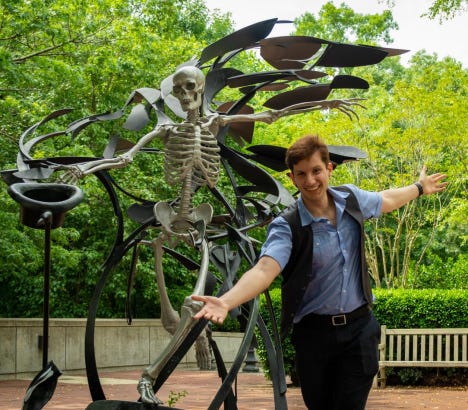
Abdallah, M.D., M.B.A., is an Internal Medicine physician in the United States whose path to medicine was forged through resilience rather than inheritance. Born in Iraq and displaced by war at the age of six, he spent eight years as a refugee in Jordan without health insurance or access to formal education.
Abdallah writes from a rare “quadruple perspective” shaped by his experiences as a former refugee patient, medical interpreter, emergency responder, and now a physician. He has lived the many sides of care, once the sick child without access to treatment, the voice translating a diagnosis to frightened families, the first responder performing CPR in moments of crisis, and now the doctor writing the orders. His writing explores the long middle of healing and what it means to live in the aftermath of survival.
Substack ID: Abdallah
If you’d like to submit a piece to be featured in a future postcard, you can check the submission guidelines here: Submit your Essays
If you’d like to support me, you can: Buy me a coffee.
 | A guest post by
|
Beautiful discussion and description of what one does initially out of their fears of abandonment and anxious attachments ! Love is for ourselves first , and when we learn to love ourselves , we learn how much to give and where to draw boundaries. I have learnt that only when we love ourselves right , can we love others right.
Happy to see your collaboration with Abdullah. Good read